The Age of Artificial Intelligence: The people behind AI

Updated: Apr 7

Last week, I had the privilege of facilitating a panel hosted by Women in Tech (BC Chapter) in Vancouver in my new role as Strategy Lead. In 2026, it’s almost impossible to host a tech event without talking about AI. But this conversation wasn’t about hype, tools, or model names. It was about people.
With over 230 attendees from technology, government, education, and industry, the energy in the room was undeniable. Canada sits at a critical point. AI adoption is accelerating fast across sectors ranking 14th in the world, yet the gap between potential and real-world impact remains clear. Women make up half of the workforce, but only a small fraction of senior leadership roles in tech. If AI is meant to work for everyone, it must be shaped by a wider range of voices, experiences, and perspectives.

Who was on the Panel?

The panel brought together leaders from government, gaming, cloud, and professional services, each offering a grounded perspective on the opportunities and challenges shaping today’s AI landscape.
Rick Glumac, BC’s Minister of State for Artificial Intelligence and New Technologies, spoke about responsible AI adoption in government, the need for public trust, and long-term policy thinking. He also talked about how the provincial government has invested over $1.3B into the tech sector in BC, contributing to the $400M Canadian economy a clear signal that AI and innovation are central to BC’s future which is super exciting. He also talked about the fact we shouldn't use AI for everything and that personal creativity is still as or more important than the machines!

Anna Baird, former Chief Customer Officer for AI GTM at Google, reflected on bias in AI systems, sharing a real example from recruitment where algorithms trained on years of male‑dominated CVs learned to favour men by default. It was a sharp reminder that AI doesn’t create bias, it inherits it.. unless we actively intervene. Her point landed clearly: in an age where answers are easy to find, asking the right questions matters more than ever. And sometimes, progress starts with confidence, backing yourself, challenging assumptions, and showing up like you belong (even though you feel like you don't sometimes).

Kate Rayner, Technical Fellow and CVP at Xbox Game Studios shared her own journey navigating bias in the industry and the confidence she has built to truly thrive. She spoke honestly about moments where she felt underestimated, and how lived experience shaped the leader she is today. From a gaming perspective, Kate highlighted that AI has been part of game development for decades, but today it acts as a powerful amplifier. AI enhances creativity for developers, supports accessibility, and creates richer, more immersive experiences for players. The message was clear. AI does not replace imagination. It expands what creators and players can do when humans remain at the centre.
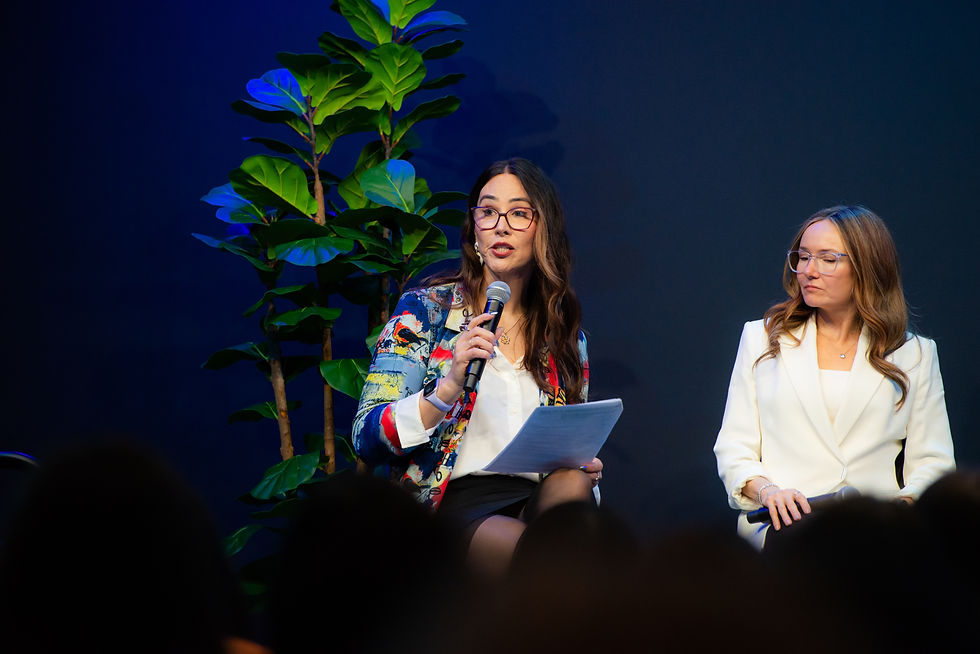
Christine Andrew, Managing Director (AI) at KPMG brought the conversation down to reality with insights from Hype to Habit: 2025 Trends in Canadian Generative AI Adoption. She shared a striking gap between ambition and outcomes.
78% of CEOs rank AI as their number one priority and investment focus
93% of organisations are already using AI
Only 2% are seeing real return on investment
Her message was clear. The challenge isn’t access to AI. It’s leadership, operating models, skills, and the hard work of turning pilots into habits that actually stick.

Coral Kennett, Head of Provincial Government and Education at AWS Canada, connected AI innovation to real public‑sector impact. She spoke about the creation of the UBC AWS Cloud Innovation Centre, where government, industry, and students work together on practical challenges across health, education, and sustainability. Her message was clear: real change happens when technology is applied to real problems, close to the communities it serves.
The conversation also tackled bias head‑on. Drawing on experience from the Amazon recruitment process, the panel reflected on how early AI hiring models were trained on historically male‑dominated CV data, unintentionally reinforcing inequality. When the issue surfaced, the AI was stripped back and redesigned into a human‑led process known as “The Loop.” It was a powerful reminder that AI must be challenged, not blindly trusted, and that progress depends on the confidence to pause, rethink, and rebuild systems with intention.

Key themes from the evening
AI is a shared responsibility
Ethics, accountability, and long‑term impact matter
Keeping humans firmly in the loop is essential
A clear counter to the “dark factory” narrative of technology replacing people
As Anna Baird noted, answers are easy to find, asking the right questions matters more
As Rick Glumac reinforced, AI should not be used for everything
AI should amplify human potential
Not replace creativity, judgement, or lived experience
Strong consensus across government, gaming, cloud, and enterprise
Inclusion drives better outcomes
Across products, policy, leadership, and systems
Women make up half the workforce but hold a small share of senior tech leadership roles
AI that works for everyone must be shaped by diverse voices
Adoption is a leadership challenge
Not a technology problem
Culture, operating models, and accountability determine real impact
Many organisations talk about AI, few see meaningful returns
Advice shared with the audience
Don’t be afraid to fail, creativity comes from experimentation
Don’t rely on AI to do the thinking, stretch yourself and your organisation
Use AI to learn, build skills, and explore new tools
You don’t need a perfect plan, curiosity, courage, and community matter more
Put on your “business suit” and act like you belong until you believe it
Final reflection
It’s clear that humans will always be essential in an AI‑driven world and that creativity, judgment, and lived experience matter more than ever. Events like this exist to connect, empower, and inspire women who are building new relationships in tech or even considering a career pivot. If you’d like to stay connected on this journey, follow Women in Tech Canada, and feel free to follow me on Linkedin or Instagram as we continue the conversation and events!


Comments